U-Visa Application Process: A Complete Guide for Crime Victims in 2026
I’m undocumented and was a victim of a crime. Can I get legal status?
Yes! If you have been hurt or scammed, the U-Visa was made specifically for you to qualify.
U-Visa Application Process: A Complete Guide for Crime Victims in 2026
If you are living in the U.S. without papers, your biggest fear is usually being "noticed", bad people and scammers know this, they target you because they think you are too afraid to call the police. They might even say, "If you tell anyone, I will call immigration".
At Elizabeth Rosario Law, we believe your bravery in speaking up deserves the right legal help, we want you to have the peace of mind that comes with a legal immigrant status in the United States. Don´t live in fear, you may still qualify for U-VISA immigration benefits even if:
You crossed the border without a visa.
You stayed past the date on your tourist or work papers.
You are currently in court for a visa case regarding deportation.
If this has happened to you, please remember: you are not a criminal for being a victim. Whether you suffered domestic violence, sexual assault, or a financial trick, you have a right to justice. The U-Visa is more than just a "temporary visa", it is a bridge built by the U.S. government to help you move forward and develop yourself without restrictions.
I was scammed—does that count for the U-Visa?
This is one of the most common questions we hear at Elizabeth Rosario Law. Many people tell us, "They never hit me, but they just took all my money."
We want you to know: your story is serious.
You do not need physical bruises or a hospital record to qualify. Under the rules of Citizenship and Immigration Services (USCIS), financial tricks and threats are serious crimes.
1. Understanding "Invisible" Crimes: Fraud and Extortion
To be a victim of a qualifying crime, you don't always need to be physically hurt. Many crimes happen through a phone screen, a text message, or a fake contract. You may be eligible for immigration benefits if you have gone through:
U-Visa Extortion & Blackmail: This is when someone scares you into giving them money. They might threaten to hurt your family or report your immigrant status to the police.
U-Visa Fraud: This often happens with "Notario" scams. Someone takes your life savings by promising you a legal status they cannot actually give you.
Financial Crime Against Immigrants: This includes "Workplace Fraud". If a boss lied to you about your job, took your passport, or used your immigration status to keep you from quitting, this is a qualifying criminal activity.
Why Financial Harm is "Substantial Harm"?
When a USCIS officer reviews your visa case, they look for proof that you suffered. This can be substantial physical or mental pain. Being scammed out of your savings or living under constant threats causes deep trauma.
We help you prove this physical or mental abuse by showing how the crime changed your life. In many cases, we suggest a psychological evaluation for your U-Visa. This helps the United States government understand that "invisible" scars are real. By showing the substantial harm the scam took on your mind, we build a wall of evidence that makes your case much harder to deny.
1. Your Bravery is the Key to Your Status
The choice is simple: when you help the police catch a criminal, the federal government helps you. At Elizabeth Rosario Law, we know this feels scary. You might think, "Why would I talk to the police about a scam?" The answer is that by helping the police, you protect others from the same scammer.
You do not need to speak perfect English to cooperate with police for a U-Visa. Our team of immigration lawyers will walk with you every step of the way. We help you get the U-Visa certification (also called the I-918B or Supplement B). This is the "Golden Ticket" that proves you were helpful and opens the door to your U-Visa work permit.
Maria’s Story: From Fear to a Work Permit
"I almost didn’t call lawyer Elizabeth Rosario because I thought they would laugh at me. I wasn't hit; I was just lied to." — Maria, an ERL client.
Maria was a hardworking mother. She saved every penny she had to give her children a better life. A local "notario" promised Maria he could get her a legal immigrant status if she paid him $5,000. Maria trusted him. But after she paid, he began to threaten her.
"I was afraid every day," Maria recalls. "Afraid to drive to work, afraid to go to the grocery store, afraid that I would be separated from my children. I knew I needed help, but I didn't know where to turn." He told Maria that if she didn't give him even more money, he would report her to Citizenship and Immigration Services (USCIS). She was terrified. Maria felt trapped by this financial crime.
When Maria finally came to see us at our Michigan office, our immigration lawyers helped Maria understand that what she went through was U-Visa extortion.
1. How Elizabeth Rosario Law helped Maria win:
Reporting without fear: We helped Maria cooperate with law enforcement (USCIS) to report the scammer. The police were focused on catching the criminal, not on Maria’s papers.
The "Golden Ticket": We worked with the detectives to get Maria her U-Visa certification ( I-918B ). This proved she was a helpful witness.
Proving the Harm: Through a psychological evaluation, we helped Maria proved the severe anxiety and substantial harm she suffered because of the threats.
The Result: Today, Maria no longer lives in fear. She received her bona fide U-Visa status. She is now legally working, has her own Social Security number, and is in line for her Green Card.
What if I’m waiting on immigration right now?
If you are like Maria and someone is scamming or threatening you, don’t lose hope.
The United States government wants to help you report these criminals. Whether you were a victim of a qualifying crime yesterday or many years ago, the path to a U-Visa case may still be open to you.
Remember, the U-Visa wait times can be long. But once we file the visa petition, you are one step closer to the work permit and the safety you deserve. You have already been strong enough to survive the crime—let your (future) immigration attorneys be strong enough to handle the legal battle for you.
What Crimes Qualify for a U-Visa? (10 Crimes You Might Not Know)
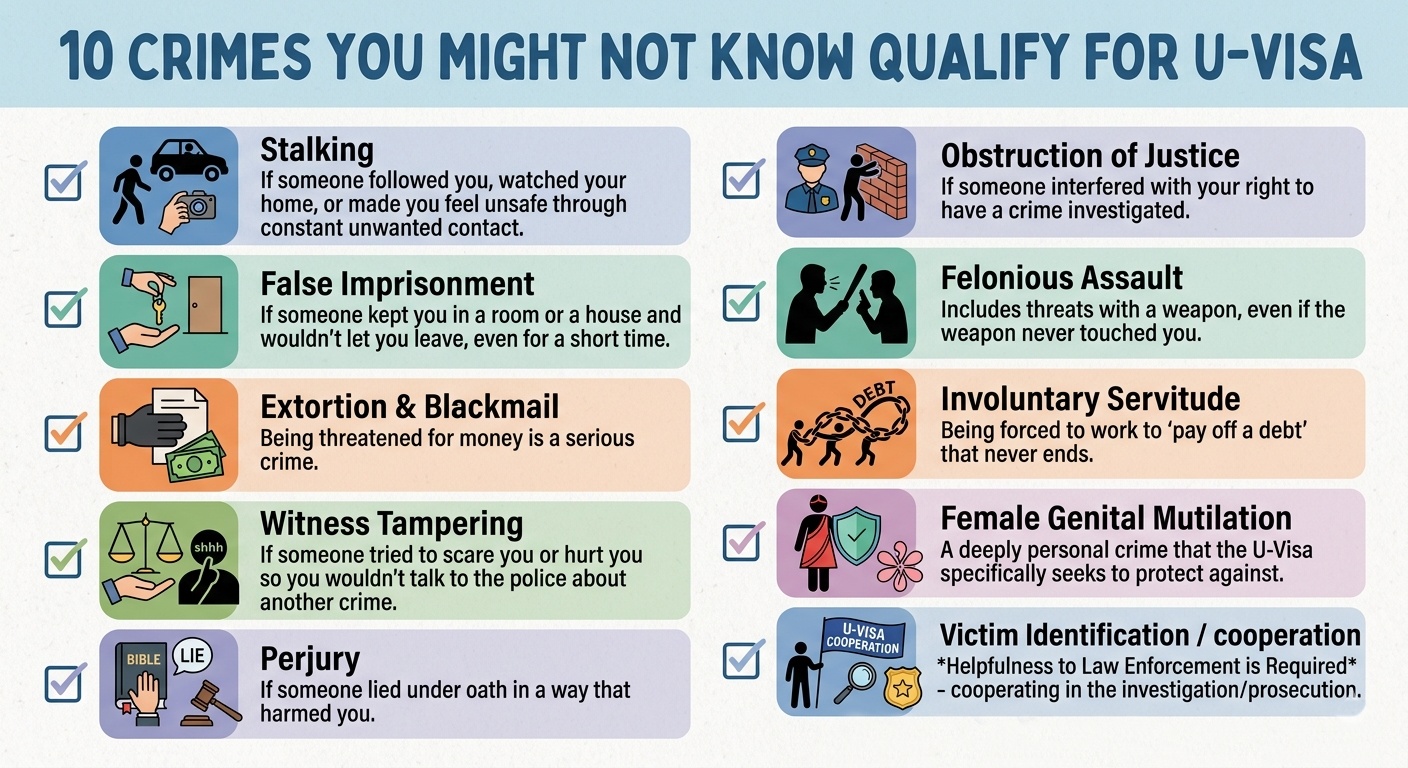
When most people think of a U-Visa petition, they think of physical violence. While domestic violence and sexual assault are common reasons to apply, the list of qualifying criminal activity is much longer.
In fact, Citizenship and Immigration Services (USCIS) recognizes over 28 different types of crimes. At Elizabeth Rosario Law, we often hear: "I didn't think I could apply because I wasn't shot or stabbed."
We want to change that. If you were a victim of a qualifying crime, you may still be eligible for immigration benefits—even if the person who hurt you never went to jail.
10 Crimes That Might Surprise You
Stalking: Someone followed you or watched your home to make you feel unsafe.
False Imprisonment: Someone kept you in a room or house and wouldn’t let you leave.
Extortion & Blackmail: Someone threatened to hurt you or report you if you didn’t give them money.
Witness Tampering: Someone scared you so you wouldn't talk to the police about a crime.
Perjury: Someone lied under oath in court to harm you.
Obstruction of Justice: Someone stopped you from having a crime investigated.
Felonious Assault: Someone threatened you with a weapon, even if they didn't touch you with it.
Involuntary Servitude: Someone forced you to work to pay off a "debt" that never ends.
Female Genital Mutilation: A serious and personal crime that USCIS specifically protects.
Kidnapping: Being taken by force, even if it was by someone you know.
You Don't Need a Conviction to Win
One of the biggest i-918 mistakes people make is thinking they must wait until the criminal is in prison. That is not true!
To win your U-Visa case, the crime only needs to have been investigated. This means as long as you filed police reports and were willing to cooperate with USCIS enforcement, you have done your part.
Your path to a U-Visa work permit stays open even if the person who harmed you ran away or was found "not guilty", as your (future) immigration attorneys we will review your old reports—even from years ago—to see if you qualify.
1. Protecting Your Family (Indirect Victims)
Sometimes, you weren't the one directly hurt, but you are still a victim. For example, if your child was a victim of a qualifying crime, you may be able to apply as an "indirect victim". USCIS knows that when a child is hurt, the whole family suffers substantial physical or mental pain.
If you have been living in fear because of U-Visa crimes, please don't wait. The U-Visa wait times are long, but the sooner we file your papers, the sooner your place in line is set. Our goal is to prove the physical or mental abuse you went through so you can get the bona fide U-Visa status you need to stay safely in the U.S. with your family.
If I go to the police, will they deport me?
This is the number one fear that keeps victims in the shadows. You might think, "If I call 911, the police will see I don't have papers and call immigration."
At Elizabeth Rosario Law, we want to tell you clearly: The answer is a resounding no.
The U-Visa was made for the exact purpose of making you feel safe calling for help. The United States government knows that if you are too afraid to report a crime, a dangerous criminal stays on the street. That makes the whole community less safe. When you call the police to report a qualifying criminal activity, their only job is to investigate the crime and protect you. They are not immigration services (USCIS) officers.
1. The "Firewall" Between Police and ICE
Think of the law as having a "Firewall" or a protective wall. On one side is the local police, and on the other side is immigration enforcement. When you cooperate with USCIS enforcement, you are in a protected lane.
In fact, USCIS says you must assist law enforcement to even apply for the U-Visa. This means that talking to the police is the key that unlocks your path to legal status. It is not a reason for removal; it is a service to your community.
If you are worried about how to start, remember that you don’t have to go to the police station alone, your (future) immigration lawyer can help you review your case first. We help ensure the prosecution of the crime moves forward in a way that highlights how helpful you were, this is a vital part of your visa case.
Turning a Police Report into a Work Permit
Reporting the crime isn’t just about safety; it’s about your future. Once you have a report, we can request the U-Visa certification (Form I-918B). This is a paper signed by the police or a prosecutor. It proves you were a victim and that you chose to cooperate with the police, without a police report, this "Golden Ticket" of U-Visa does not exist.
Even if you were told you have no options because you entered without a visa, this path is still open to you.
Don't let fear keep you trapped in a situation of abuse. By reporting the crime, you take the power away from the criminal. You give yourself a chance to work while waiting for your residency. At Elizabeth Rosario Law, we have helped thousands of clients beat this fear to find their voice and their legal security.
U-Visa vs. VAWA: Which is better for me?
If you have been hurt by a spouse, a parent, or even a child, you might feel like you are at a crossroads. You know you need help, but you might wonder: "Which law is the right shield for me?"
At Elizabeth Rosario Law, our goal is to find the path that gets our (future) clients results the fastest, by understanding the difference between U-Visa and VAWA.
The main difference usually comes down to who hurt you. As we explained in our guide on VAWA confidentiality, VAWA is a powerful tool if the abuser is a United States Citizen or has a Green Card. But if the person who hurt you does not have legal papers, the U-Visa becomes your strongest ally.
1. Why Choose VAWA? (The Self-Petition)
VAWA is often the faster choice for a few reasons:
No Annual Limit: Unlike the U-Visa, which only gives out 10,000 visas a year, VAWA has no limit.
No Police Report Needed: While the U-Visa asks you to cooperate with USCIS enforcement, VAWA focuses on the abuse you suffered. You can prove your case with medical records or photos without involving the police.
Total Privacy: The federal government is strictly forbidden from telling your abuser that you applied. You can fix your status without them ever knowing.
2. Why Choose the U-Visa? (The Community Shield)
The U-Visa is your path if the abuser is undocumented, or if the person who harmed you was a stranger, a neighbor, or a boss.
Broad Protection: The U-Visa covers over 28 qualifying criminal activities, including domestic violence and sexual assault.
A Reward for Help: The U-Visa is a reward for helping the police. By filing police reports and helping with the prosecution of the crime, you earn the right to stay legally.
Bona Fide Benefits: Even though U-Visa wait times are longer, you can get a U-Visa work permit and protection from deportation while you wait in line.
Can they work together?
Sometimes, a survivor might qualify for both. In those cases, your (future) immigration lawyer will review your visa case to see which one is safer for you. For example, if you are very afraid of your abuser finding out, VAWA is a huge benefit. If you already helped the police, the U-Visa might be a great "Plan A". Remember, you are not alone in this.
Whether it is a VAWA self-petition or a visa petition for a U-Visa, Lawyer Elizabeth Rosario´s goal is the same: to take the "tool of control" away from the person who hurt you. If you aren't sure which path to take, contact us for a free case evaluation. We will look at your immigrant status and to find the best plan for your future.
How do I get police to sign my certification?: The "Golden Ticket"
In the world of immigration, we call the I-918B (or Supplement B) the "Golden Ticket."
Why? Because without this one piece of paper, you cannot even start your visa petition.
This form is the bridge between your bravery at the police station and your legal status with Citizenship and Immigration Services (USCIS). It is an official paper where a detective, a prosecutor, or a judge signs their name to prove two things:
A qualifying criminal activity really happened.
You were helpful and chose to assist USCIS officers.
We know that for many people, going back to the police feels scary. You might worry they won't remember you or that they will say no. Lawyer Elizabeth Rosario, wants to let you to know: you do not have to go to that police station alone. Getting this paper is a technical job. We have mastered the "art of the certification" to make sure the right people hear your story.
Who has the power to sign?
Many people think only the officer who took their report can sign the supplement b U-Visa. That isn't true! There are several people who can help:
Police Departments: The detectives or the Chief of Police in the city where the crime happened.
Prosecutors: The District Attorney’s office that worked on the criminal case.
Judges: If your case went to court, a judge can sign the U-Visa certification.
Child Protective Services (CPS): In some cases where children are involved, CPS can sign for you.
1. What if they say no?
We want to be honest with you: the police are encouraged to sign, but the federal law doesn't force them to. This is why having your experienced (future) immigration lawyer is so important. Sometimes, a request is denied just because it went to the wrong office or the police reports were missing a few details.
If one office says no, we don't give up. We look for other options. We might reach out to a prosecutor or check if a different agency can sign. We handle the phone calls and the legal talks to make sure your choice to cooperate with law enforcement is officially recognized.
2. Timing is Everything
Once an official signs your "Golden Ticket," you only have six months to send it to immigration services (USCIS). If that clock runs out, the paper expires. You would have to start all over again! our goal is to get that signature and file your application immediately. We want you to get on the U-Visa waitlist as soon as possible so you can start your journey toward a U-Visa work permit.
Why does the U-Visa take so long? (And what to do while you wait)
We know that hearing a U-Visa wait time of 8 to 12 years feels scary. You might ask, "How can I wait that long to be safe?" At Elizabeth Rosario Law, we believe in being honest. The wait is long because the United States government only gives out 10,000 visas a year, but over 250,000 people are waiting in line.
However, there is great news for 2026! You do not have to wait until the end of that line to get protection.
The U-Visa is a test of patience, unlike the T-Visa which moves much faster. But thanks to a new rule, USCIS now helps you feel safe while you wait. Instead of living in fear for ten years, you can get a "pre-approval" that changes your life much sooner.
The Bona Fide Determination (BFD)
In 2026, the bona fide U-Visa check is your most important goal. About 35 months after we file your visa petition, Citizenship and Immigration Services (USCIS) will do a first review of your case. If they see your case is complete and you are a law-abiding person, they give you "Bona Fide" status.
Once your case is “Bona Fide”, you receive:
Deferred Action: This is a fancy way of saying you are protected from deportation. The "shadow" you have been living in finally disappears.
A Work Permit (EAD): You can finally work legally, get a Social Security number, and take care of your family with pride.
Peace of Mind: You are officially "in the system." The U.S. government is now committed to protecting you.
1. Healing Your Heart While You Wait
We often tell our (future) clients that this isn't just a legal case; it’s a journey toward healing. The Bona Fide Determination was made to support your mental health.
Even though the final Green Card is still years away, the work permit and deportation protection let you build a real life. You can buy a home, get a better job, and deselvoled without fear.
At Elizabeth Rosario Law, we don't just file your papers and disappear. We stay by your side through every year of the U-Visa waitlist. We track your priority date and help you renew your work permit so you are never left alone. The line may be long, but once you get that "Bona Fide" approval, the hardest part of the wait is over.
"Do I get a work permit?" and Other Work Benefits
For many of our clients, the most emotional day of their visa case isn't the day they file the papers. It is the day they check the mail and find their U-Visa work permit. This card is officially called an Employment Authorization Document (or EAD).
In 2026, the bona fide U-Visa rules mean you can get this permit much faster than in the past. Once Citizenship and Immigration Services (USCIS) approves your "Bona Fide" status, they can give you a work permit that lasts for four years. This is the federal government’s way of helping you stay safe and financially stable while you wait for your final visa.
1. More Than Just a Job: The Benefits of an EAD
Having a U-Visa ead opens doors that were locked before. It isn't just about work; it’s about having a legal identity. When you get your work permit, you also get:
A Social Security Number (SSN): This lets you open a bank account, build credit, and file your taxes legally.
A Driver’s License: In almost every state, your EAD and SSN are the keys to getting a license. You can drive your kids to school or go to work without fear of being pulled over.
Better Pay and Safety: You don't have to work "under the table" anymore. You can apply for good jobs with companies that offer insurance and fair pay.
2. Breaking the "Tool of Control"
We often see abusers or bosses use a person’s immigrant status to keep them trapped. They might say, "If you leave me, you’ll starve because you can't work," or "I don't have to pay you fair wages because you don't have papers." This is a "tool of control."
The U-Visa work permit takes that tool and throws it in the trash. It gives you financial independence. This is a big part of healing from the physical or mental abuse you suffered.
When you have your own money and a legal standing, you have the power to walk away from bad situations. Your (future) immigration attorneys work hard to make sure your application is perfect so you can start your new life and take care of your qualifying family member.
Do I need to see a therapist? Strengthening Your Case
One of the most common things we hear at Elizabeth Rosario Law is, "I don’t have medical records because I didn’t go to the hospital."
We want you to know that your scars don't have to be visible to be real. To win a U-Visa case, the applicant needs to prove that they suffered substantial physical or mental abuse. While a doctor’s note proves a broken bone, a psychological evaluation for a U-Visa is often the best way to prove the emotional harm you’ve gone through.
Think of this evaluation as a "medical report for the soul". It is an official paper written by a mental health expert. It explains to the USCIS officer how the crime changed your life. Whether you feel anxiety, sadness, or have nightmares (PTSD), these are not "just feelings".
Why a Professional Report Matters

When a specialist sits down with you, they aren't there to judge you. They are there to help you put your pain into words that the USCIS understands. A professional report can show:
The Impact on Your Life: How the crime makes it hard for you to sleep, work, or trust people.
The Depth of Your Trauma: How the threats or violence created a lasting "invisible" injury.
The Need for Safety: Why staying in the United States—where you have support—is vital for your recovery.
We know that talking about what happened can be painful, you might feel like you are "reliving" the nightmare. However, your (future) immigration attorneys will work with a network of kind, bilingual experts who understand the U-Visa process. ERL creates a report that truly reflects your strength and your struggle.
By including this evaluation in your visa petition, you give Citizenship and Immigration Services (USCIS) a complete picture of your life. It turns your "word" into "expert evidence." This doesn’t just strengthen your visa case; it validates your journey.
My child was a victim—can they apply?
At Elizabeth Rosario Law, we have sat with many parents who feel a "double weight". They feel the pain of what happened to their child, and they fear that their immigrant status will stop them from getting justice.
Lawyer Elizabeth Rosario wants to give you a message of hope:
“If your child was a victim of a crime, the U-Visa is made to protect them and you. In many cases, an undocumented parent of a U.S. Citizen child can file a visa petition as an "indirect victim."
Because a child is young, they cannot be expected to talk to the police or go to court alone. USCIS allows you, the parent, to assist law enforcement for them. By providing police reports and choosing to cooperate police U-Visa, you meet the rules to fix your own papers.
1. Keeping the Family Together: Derivatives and "Age-Out" Rules
One of the best parts of the U-Visa is that it is built for families. If you are the one applying as a victim of a qualifying crime, you can include your spouse and your unmarried children under 21 in your visa case. These family members are called "derivatives." This means when you get your U-Visa work permit, they can often get one too. It helps the whole family move from fear to legal safety together.
We also know that the U-Visa waitlist is long. Many parents worry: "What if my child turns 21 before the visa is ready?" This is where minor protection rules come in. In 2026, USCIS "freezes" your child’s age on the day you file the i-918 papers.
As long as they were under 21 and unmarried when we started, they are safe. Even if they turn 21 while waiting for Citizenship and Immigration Services (USCIS) to finish the case, they will not lose their chance at a Green Card. We handle these details with extra care because your child’s future is your biggest priority.
Why was my U-Visa denied?
When a visa petition is denied, it is a heartbreaking moment. But at Elizabeth Rosario Law, we know a denial is almost never because a person didn't "deserve" it...
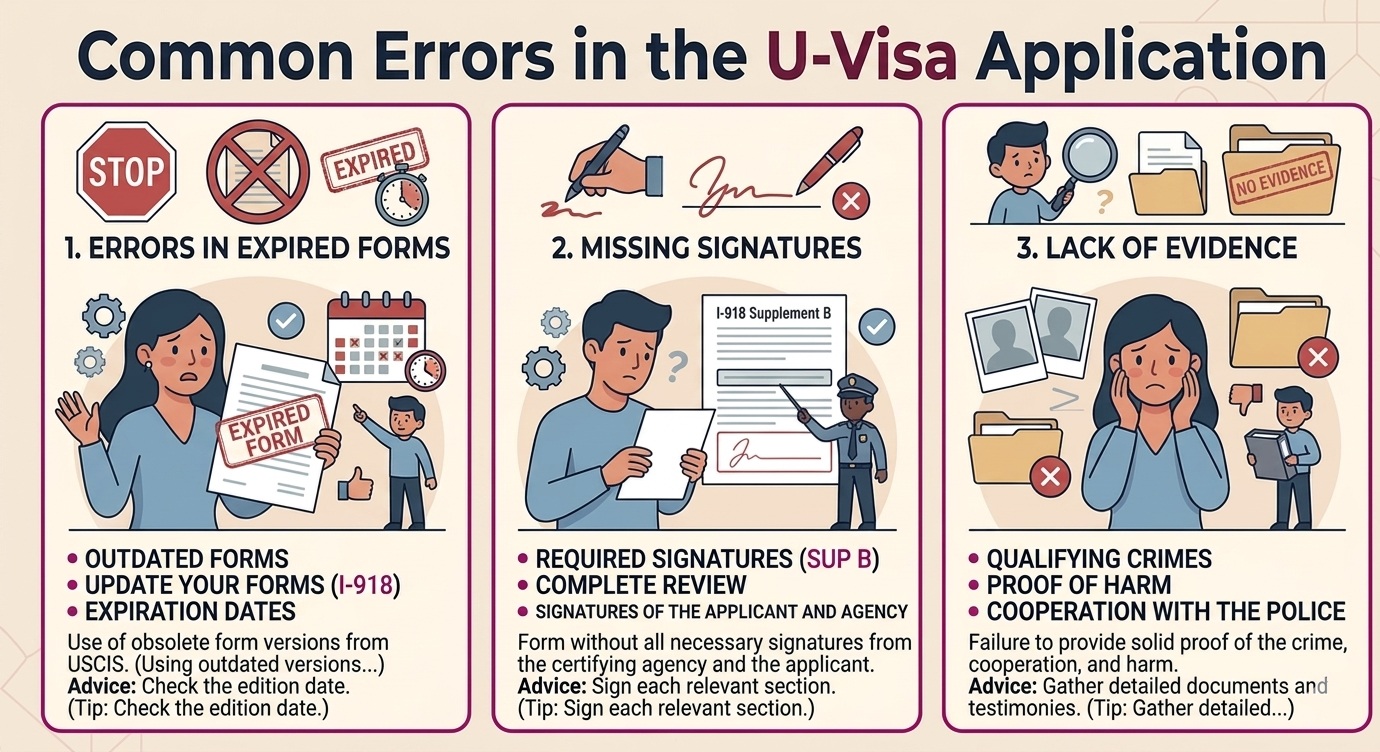
...Most of the time, it happens because of a small mistake on the papers. The Citizenship and Immigration Services (USCIS) rules are very strict. Even a tiny error or a missing signature can cause a USCIS officer to reject the whole case.
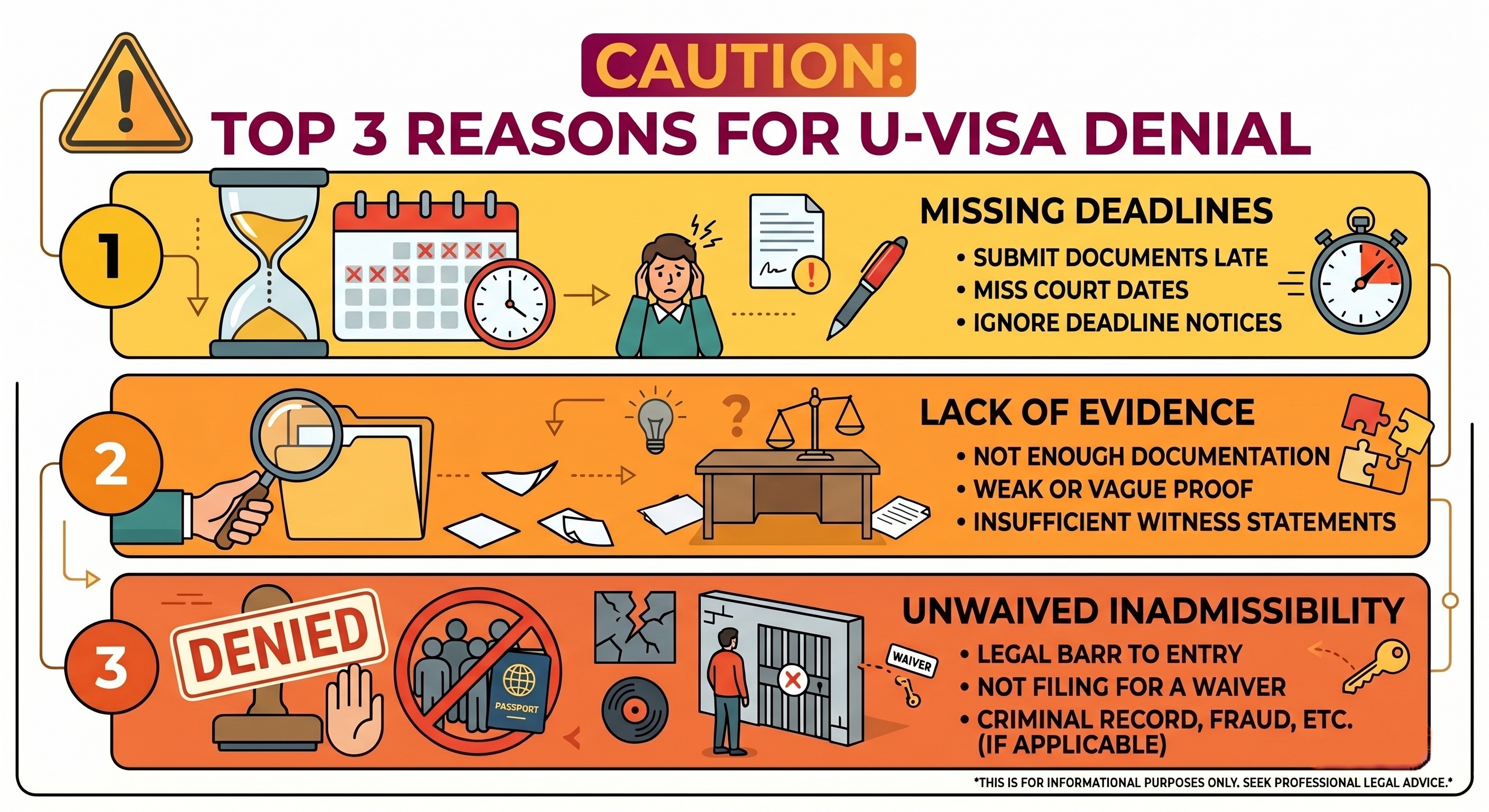
Know the "red flags" so you can feel safe
Our 98% case approval rate is not an accident, we have it because we are obsessed with every detail. Here are the most common i-918 mistakes and how we protect you:
1. The "6-Month Clock"
One of the most common U-Visa errors is missing the deadline for your Supplement B. Once the police sign your U-Visa certification, you only have six months to send it to USCIS. If you wait even one day too long, the "Golden Ticket" expires, USCIS will deny your case.
2. Not Enough Proof of "Substantial Harm"
The government needs to see how the crime changed your life. If you only send a police report but don't explain your physical or mental abuse, they might say you don't qualify. This is why we work so hard on your psychological evaluation for a U-Visa.
3. The "Hidden Trap" (Inadmissibility)
If you crossed the border without a visa or used a fake paper to work in the past, the government might call you "inadmissible." Many people face a U-Visa denial because they didn't know they needed a special "pardon." This is a Form I-192 waiver.
4. Not Answering the Government's Questions
Sometimes USCIS sends a letter asking for more proof. This is called an "RFE." It is not a denial, but it is a final warning. If you don't answer correctly and on time, your case will be closed. We handle all talks with immigration services (USCIS) for you. We make sure every question is answered with a mountain of evidence.
You Don't Have to Face This Alone
Navigating the immigration services (USCIS) system shouldn't be another source of stress in your life. Attorney Elizabeth Rosario and her dedicated bilingual team are here to give you back your voice, your confidence, and a legal status.
Whether you are in Michigan, North Carolina, or anywhere else in the United States, we are ready to listen to your story with the empathy and respect you deserve.
Let’s Turn Your Fear Into a Future
Every case at Elizabeth Rosario Law starts with a private, free case evaluation. We will look at your visa case, and help you understand exactly which "hidden paths" are open to you. Ready to take the first step? Don't let another day go by feeling unprotected.
[Schedule Your FREE Evaluation Today]
Our immigration lawyers have helped over 10,000 families navigate the immigration system. We are proud of our 98% case approval rate!
Call (855) 627-2292 | Serving clients in all 50 states with offices in Wyoming, Michigan; and Charlotte, North Carolina.
Disclaimer: This content is for general informational purposes only and does not constitute legal advice. Immigration laws change frequently and the information here may not reflect the most current legal developments. Consult an attorney for advice on your specific situation.
Elizabeth Rosario, Esq.
Immigration Attorney with over 15 years of experience helping families navigate complex immigration matters.
Newsletter
Subscribe to our newsletter for important immigration law updates and resources for your case.
We respect your privacy. You can unsubscribe at any time.