What Do I Do If ICE Shows Up at My Door?
If you've ever felt concerned about the potential impact of an unannounced visit from Immigration and Customs Enforcement (ICE), rest assured that you're not alone in this. At Elizabeth Rosario Law, we've put together this guide to help transform your uncertainty into a plan of action.
What Do I Do If ICE Shows Up at My Door?
It's really important to understand your civil liberties and create a plan to protect yourself and your loved ones; because being prepared isn't just something the law requires, it's your best defense. Whether you possess a green card, a T-Visa applicant, U-Visa, or looking for an immigration status, understanding your Constitutional Rights, it is your primary line of defense.
Elizabeth Rosario Law (ERL) is here to guide you through the necessary steps to protect your home. If you've ever wondered, “What should I do if ICE shows up at my door?” know that you're not alone.
Don´t Open your Door
Encountering ICE officers near your home can be an overwhelming experience, but how you respond in that moment can significantly impact your case. Taking these steps allows you to safeguard your legal rights and maintain your family's peace of mind.
1. Keep the Door Locked
The most important thing is to remain silent. You have the right to keep your door closed, and don't open it unless ICE officers hold up a judicial search warrant signed by a judge. You can have a chat with them through the closed door or a window; you don't need to let them inside to have a conversation.
2. Verify Who is Outside
You have the right to know who you are speaking with. Tell the immigration law officer to show you their badge and identification through the window. If they claim to have a search warrant, you have the legal right to demand that they hold it up to the glass or slide it under the door so you can examine it closely.
Document the situation with your phone, but do it discreetly so you don't escalate the tension. A legitimate ICE agent should be willing to show you their identification.
3. Gather Your Family
Gather everyone, including your children and any guests, into one room away from windows and doors. Do it quickly and quietly, this approach ensures everyone remains calm and avoids confusion.
Make sure everyone in your household is familiar with the plan: they should remain silent and let you take the lead in speaking with the ICE officer. This approach reduces the risk of anyone unintentionally saying something that could be misused against your family later.
4. Create a “Digital Record”
If you feel safe doing so, you have the legal advice to take note of the time, the number of ICE officers, and their attire. These small details will be of immense help to your legal case later on.
5. Seek Legal Advice
Have the number of your (future) Immigration Attorney at Elizabeth Rosario Law Group handy as soon as you realize that ICE is at your door: (855) 627-2292.
Many cities offer 24-hour emergency hotlines specifically for these types of situations, like the the National Immigration Detention Hotline. Speaking with an immigration attorney over the phone can provide you with the guidance and support you need to handle the situation appropriately.
Understanding Your Rights
When ICE agents arrive at your home, it's important to remember that they're operating within a federal system. No matter what your immigration status is, you are protected by the Constitution of the United States the very moment immigration and customs enforcement (ICE) knock on your door.
Remember, knowing your rights will give you the strength to handle the situation with confidence. At Elizabeth Rosario Law we're here to make sure you feel determined of the tools you have to stand your ground.
Your Right to Remain Silent:
The right to remain silent under the Fifth Amendment is the most powerful tool in your legal defense; it reminds us that you have no legal obligation to disclose information about your place of birth, how you entered the United States, or your current immigration status.
What to do?: Speak firmly through the door: “I am exercising my right to remain silent under the Fifth Amendment, and I will not answer any questions without my (future) immigration attorney from Elizabeth Rosario Law present.”
Why this protects you?: Anything you say has the potential to be used as evidence against you in future removal proceedings. Choosing to remain silent allows you to avoid the risk of unintentionally saying something that could harm your case.
Your Right to Refuse Entry Without a Warrant
Under the Fourth Amendment, you should know that your home is a “protected space”. ICE officers cannot enter your private residence without your explicit consent, unless they possess a judicial search warrant signed by a judge or magistrate.
What to do?: Keep your door closed and locked. Ask the law enforcement officers to slide the search warrant under the door or hold it up to a window so you can read it. If you don't see a signature from a judge, you have the legal right to keep them outside.
The “Never Sign” Rule: Do not sign any document, some may be labeled “Order of Deportation” or “Voluntary Departure.” Despite the pressure you may feel, signing any document could result in in future removal proceedings, and you could even face a re-entry ban for several years, as well as disrupt any pending legal proceedings.
Your Right to a Lawyer
You have the right to legal advice before signing any papers or answering any questions. If an ICE agent pressures you to sign anything, or wants to make unreasonable searches and seizures, you have the legal right to say no.
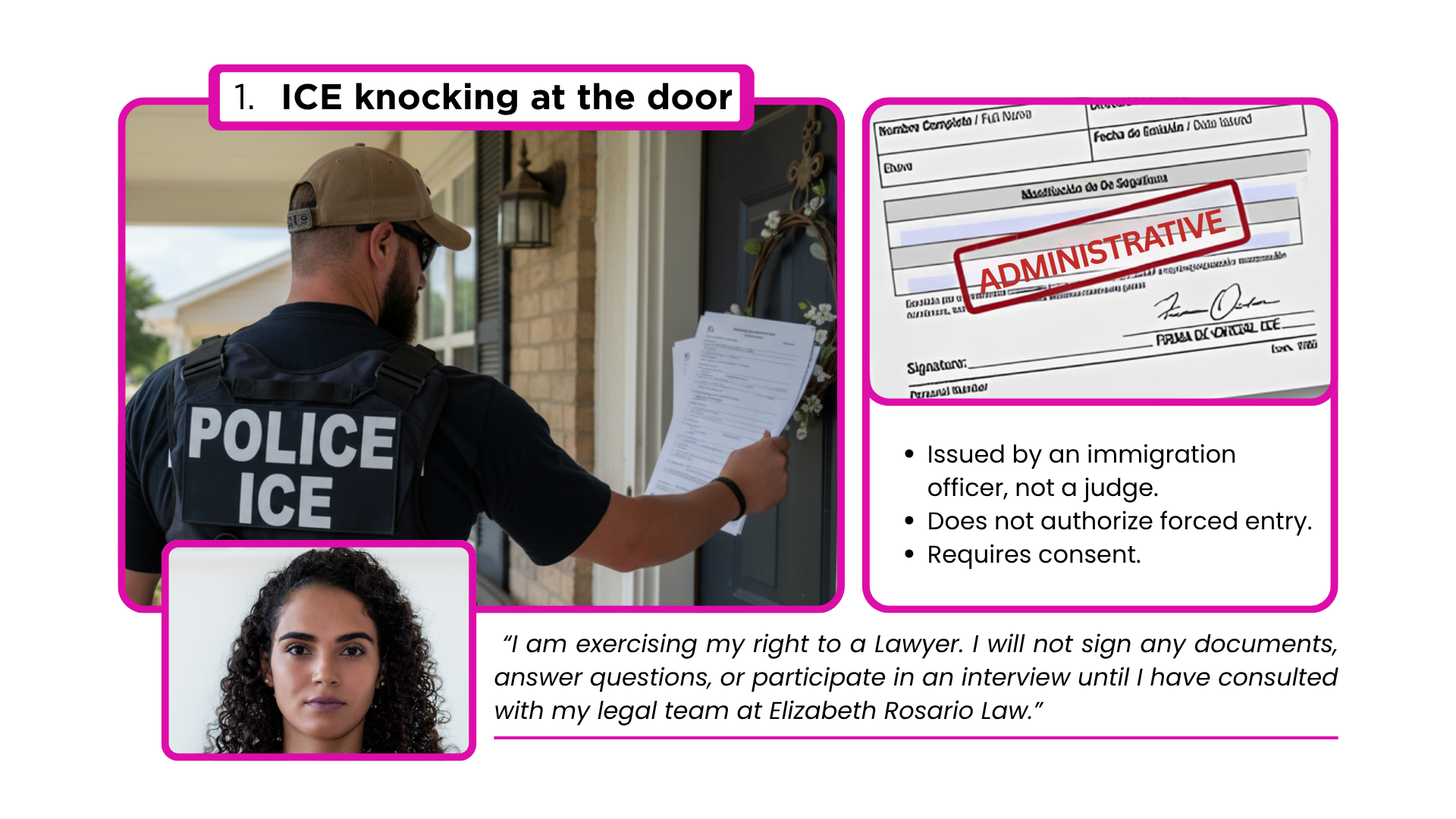
What to do?: State clearly: “I am exercising my right to a Lawyer, and will not sign any documents, answer questions, or participate in an interview until I have consulted with my (future) immigration legal advice team at Elizabeth Rosario Law.”
How we protect you?: Having an attorney ensures that your case is handled with precision, preventing the unintentional loss of your legal rights.
Hiring the specialized immigration attorney team at Elizabeth Rosario Law ensures your case is managed with thorough attention to detail:
Check if the agents followed the law: If an ICE agent entered your home without a judicial search warrant, any evidence they found shouldn´t be used against you.
Find your best path forward: Our immigration law firm is dedicated to helping you explore every viable option, as many situations qualify for protections such as the T-Visa, U-Visa, or Cancellation of Removal, without being aware of their eligibility.
1. Helpful Resources
It’s important to know that, although you have the right to an attorney, the United States government is not obligated to provide one free of charge for immigration-related cases. Therefore, making a plan and staying in touch with your legal advice team is one of the best decisions you can make for yourself and your family.
Understanding Search Warrants
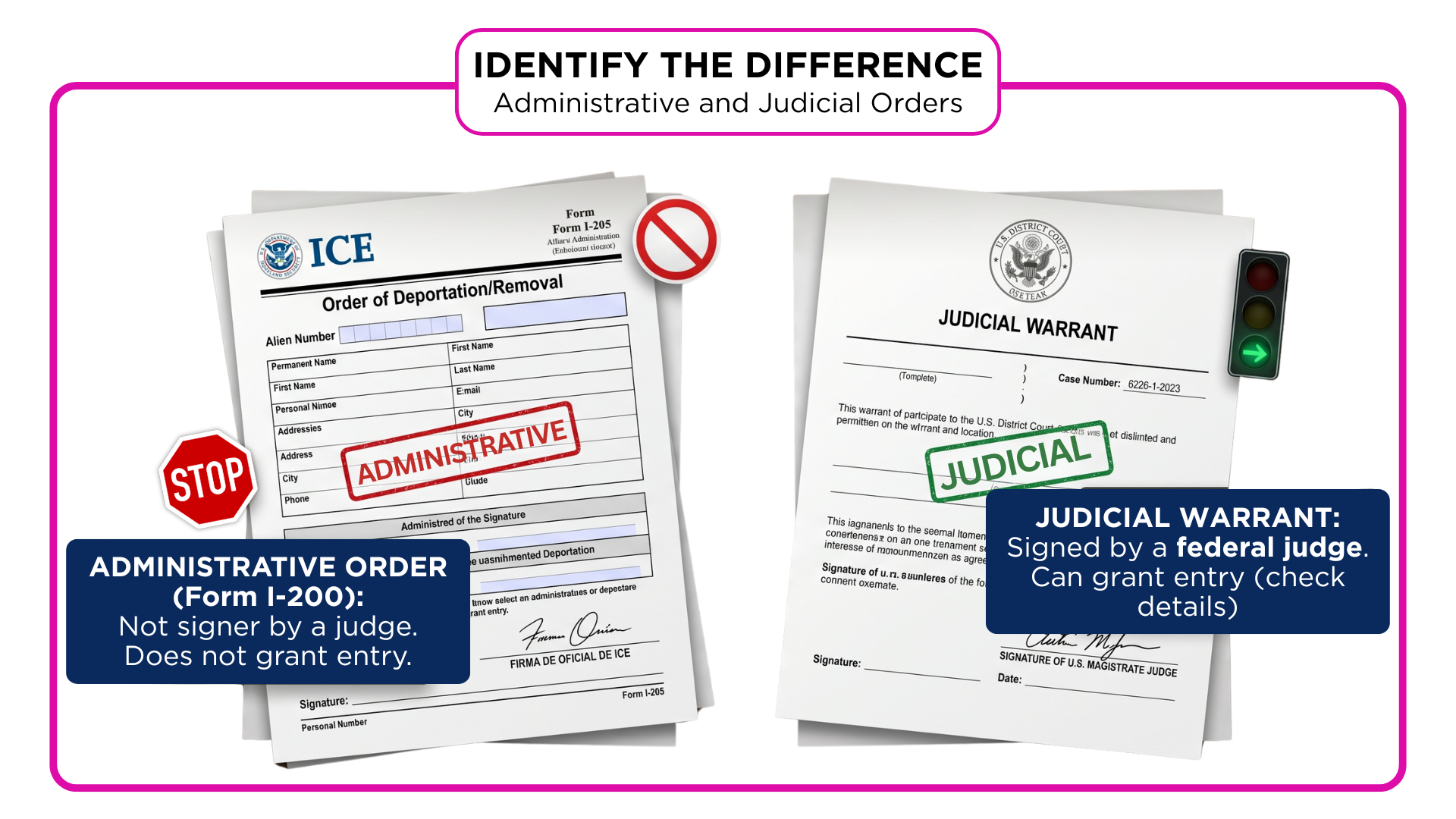
This can be confusing but remember that an administrative warrant (like Form i-200 or i-205) is only signed by an ICE agent, not a judge. This does not give them the right to enter your home.
The Difference Between Warrants
One of the most common ways people are pressured into allowing lCE officers inside their home is through a misunderstanding of search warrants. ERL aims to help you quickly distinguish the difference so you can protect your front door. Both judicial and administrative warrants serve as legal orders permitting searches and seizures, but they differ notably in their objectives, the proof needed, and the authority responsible for issuing them.
The Judicial Search Warrant (Your “Red Light” for Entry)
A judicial search warrant is a court order issued by a judge or magistrate, granting legal authority to enter private property, seizure, or making an arrest. This clearance is based on probable cause, believing that a crime is being committed or is actively underway.
A valid judicial warrant will outline the address to be searched, will provide a detailed description of the location, person, or both, as well as the items to be seized. If such a warrant is presented to you through a window, and it's signed by a judge, you generally have to let them in. However, you should still practice your right to remain silent and call your immigration lawyer immediately.
The Administrative Warrant (Your “Stop Sign”)
An ICE administrative search warrant is a document that is issued by a federal agency, not by a judge, such as the Department of Homeland Security (DHS) or Immigration and Customs Enforcement (ICE). This paper doesn't give them the right to enter your home. If this is all they have, you can keep your door locked and kindly let them know, “I do not consent to your entry”.
Keeping Yourself Safe from Tactics
Sometimes, ICE agents may use “ruses” or creative tactics to get you to open the door. They might say they're local police investigating a crime in the neighborhood, or they ask for someone who doesn't live with you. Here's some advice Lawyer Elizabeth Rosario would like to share with you:
If you see someone you don't recognize, please don't hesitate to ask for identification through the window.
It's always a good idea to remember that local police and ICE officers typically wear different uniforms and badges. If you are unsure, you can ask them to leave a business card or their contact information under the door so your immigration lawyer can verify who they are.
You have the right to be cautious and to verify the truth before you ever turn that deadbolt.
What to Say and What to Avoid Saying?
We all know that moments of high stress can make it hard to think straight, and it's normal to want to explain your situation or be helpful to immigration law officers. But remember that your words are your most powerful defense.
Immigration Attorney Elizabeth Rosario invites you to consider these statements as your “voice of protection”. ERL is here to help you prepare and feel confident when communicating, should you ever find yourself in that situation.
What Can You Say?
You can use these special phrases to communicate through your closed door or a window. They're there to let ICE officers know that you're aware of your civil liberties:
“I am exercising my right to remain silent”: This is the most important thing you can say. It lets them know that you won't be answering questions that could be used against you in a later moment.
“I do not consent to your entry”: Saying this clearly lets immigration and customs enforcement agents know that you're not giving them the green light to come into your home.
“I want to speak to a lawyer”: This is a sign that you're asking the call to get the support of a professional immigration legal team.
“Do you have a judicial warrant signed by a judge?”: This specifically asks for the supreme court legal authority. If they only have an administrative search warrant signed by an ICE agent, they cannot enter your home.
“Please show me the search warrant through the window (or slide it under the door)”: This allows you to verify their paperwork without opening your door.
What Should You Never Say? (And Why it Matters)
During these encounters, remaining silent is often your best ally. We know that when you’re facing an immigration officer, you may feel under a lot of pressure, and we want to assure you that we’re here to support you. If you feel confused or want to clear up a misunderstanding, avoid revealing the following details:
Your Immigration Status: Keeping your immigration status private will help protect you from any potential misuse of your words.
Where You Were Born or How You Entered the Country?: Details about your home country or your journey to the United States are sensitive pieces of information. You're have the right to remain silent.
Information About Your Loved Ones: Try not to discuss the location or well-being of your spouse, children, or roommates. Protecting their privacy is just as important as protecting your own.
Anything That Isn't True: Never give anyone false information or fake documents, providing something that isn't real can lead to some serious legal issues. If you aren't sure what to say, it is always safer to say nothing at all.
Your Signature on Paperwork: Don't sign anything, even if it looks official, or they promise it will help you, until your (future) lawyer at Elizabeth Rosario Law has had a chance to read it. It's always a good idea to be careful with documents, sometimes a seemingly simple form could actually be an agreement to leave the country.
Understanding ICE's Authority
Knowing what immigration and customs enforcement can and cannot do significantly reduces fear. By understanding the extent of their power, their legal limits, you can defend your legal rights more effectively.
What ICE officers Can and Cannot Do
It's helpful for you to think of ICE agents as having a specific “set of rules” they must follow:
In Public Spaces: ICE agents might come up to people in public places, like streets or parking lots, if they have a good reason to think someone might not have the right documents. However, even when you're with other people, you still have the legal right to remain silent and to contact an attorney.
At Your Home: If ICE agents enter without that specific search warrant or your clear “yes”, they are overstepping their legal bounds. Unless they have a judicial search warrant.
Cooperation and Signing: Immigration and Customs Enforcement can't force you to sign any documents or answer their questions without a proper legal process involving a judge and your civil liberties.
What if ICE Agents Stop You in Your Car?
You might be wondering if your car is subject to the same legal protections as your home. If you’re ever pulled over or approached by officers while in your car, don’t worry! both spaces are protected by The United States Constitution. Here are some tips to help you stay safe:
Stay Inside and Keep Your Hands Visible: If you see blue lights or ICE agents approaching, please pull over safely, turn off the engine, and keep your hands where the ICE officers can see them.
You Still Have the Right to Remain Silent: You don't have to answer any questions about where you were born, your immigration status, or where you're going, you can simply say: “I am using my right to remain silent”.
The Right to Refuse a Search: ICE agents ask to look inside, like your glove box or trunk, you have the civil right to say: “I do not consent to a search of my vehicle”.
Don't hand over any false documents: If an ICE agent ask for your identification, and you are the driver, you should have ready a valid driver's license. However, never give them any documents or passports from other countries, as that might be used against you.
The Right to Ask if You Are Free to Go: If you're being questioned by law enforcement officers and you're not under arrest, you can ask the ICE agent calmy “Am I free to leave?”, if they say yes, you should drive away slowly and calmly; if they say no, you have the right to let them know you'd remain silent until you can speak with your (future) immigration lawyer at Elizabeth Rosario Law.
Protecting Your Family
Whether you have young children or a roommate with different immigration statuses, your main goal is to make sure everyone knows how to act; if you prepare your loved ones now, you can turn a potentially chaotic moment into a calm and organized defense.
Caring for Your Children During an Encounter
It is essential to talk to your children beforehand so they understand the possibility of an encounter with immigration and customs enforcement in a way that does not scare them, but rather prepares them.
The Rule of “remaining silent”: It's always a good idea to teach them to remain silent and calm if an ICE Officer knocks on the door. Please remind them that only the adults in the house should talk to the people outside the door.
Proof of Citizenship: If your children are United States citizens, it's a good idea to have their birth certificates or passports ready. While you don't have to show them unless there's a judicial search warrant involved, having them can help clarify their status quickly if the situation escalates.
Emotional Support: It's so important to let your kids know that you have a plan and that you're doing everything you can to keep them safe. This can really help to put their minds at ease during a stressful time.
Supporting Mixed-Status Households
In many families, members have different legal protections, for example, through a T-Visa, while others may be seeking immigration status.
Individual Rights: The United States Constitution seeks to protect all people, regardless of their specific circumstances. It is essential that all members of your household know their legal rights.
Unified Silence: Even family members who are U.S. citizens should be careful, sometimes when a citizen is trying to “help”, they might accidentally share information about a loved one, and later on the case ICE officers could use it. The best thing for your family at that moment is to stay calm and let your (future) immigration lawyer do the talking.
Avoid Outing Others: Please make sure that no one in the house points out or identifies other family members to the agents.
1. Preparing Household Members and Guest
If you live with roommates or have guests visiting, they are part of your “protected space”. It's important to make sure they're on the same page as you.
The Shared Plan: Make sure every adult in the house knows where your emergency contact list is kept.
Consent is Personal: Don't forget to remind everyone that they also have the right to refuse entry to the ICE agents. If one person lets immigration and customs enforcement in without a judicial search warrant, it could put everyone in the house at risk.
2. A Note on Your Car
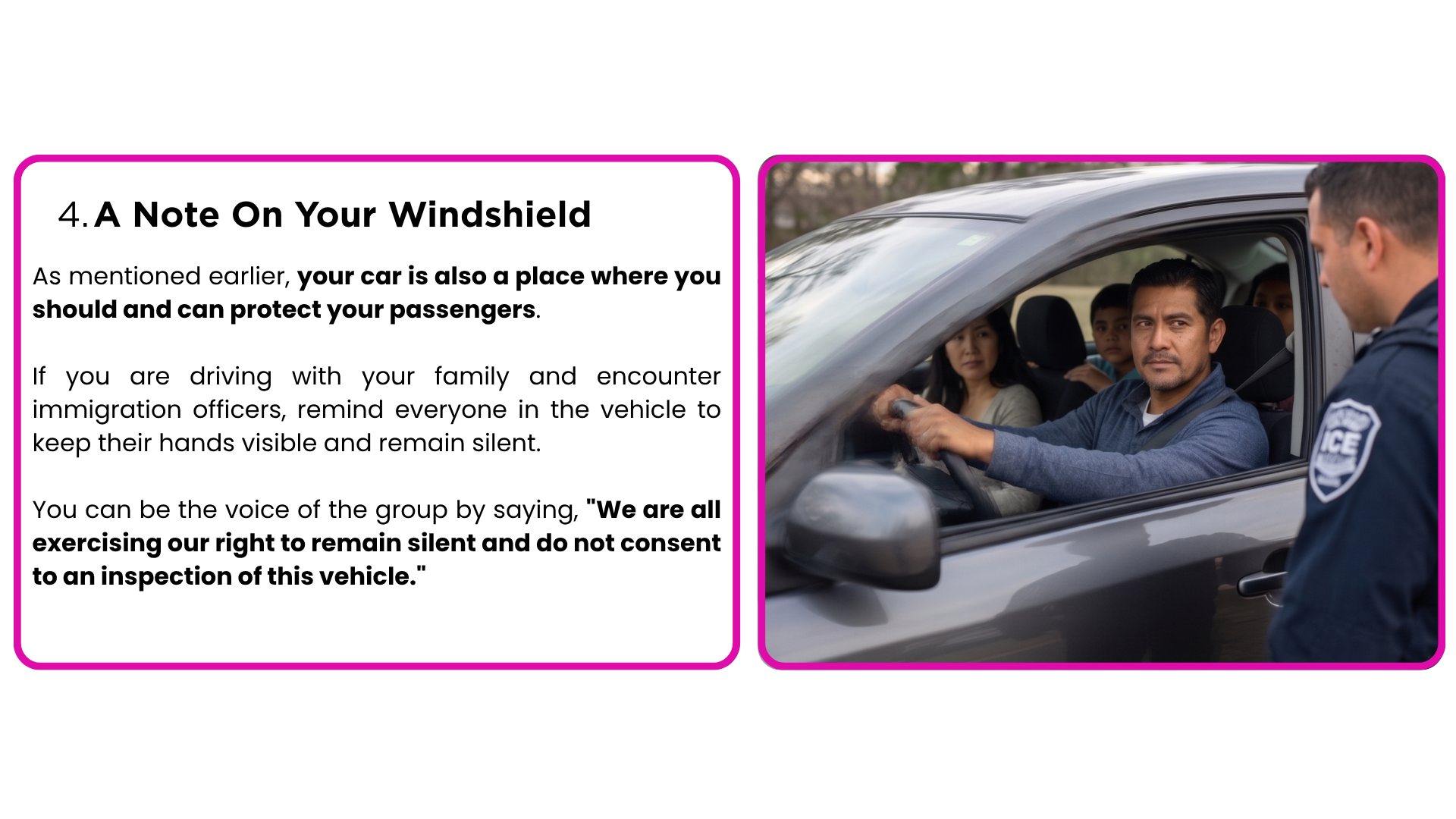
As we discussed earlier, your car is also a place where you must protect your passengers. If you are driving with family and are approached by ICE agents, remind everyone in the vehicle to keep their hands visible and to remain silent. You can be the voice for the group by stating: “We are all using our right to remain silent and we do not consent to a search of this vehicle”.
Emergency Plan
When you're ready, you can replace feeling overwhelmed with a sense of purpose. Having a clear plan is your “security folder”, you hopefully might not ever have to use it, but just knowing it's there can give you a sense of peace.
Organizing Your Vital Documents
In a moment of stress, you shouldn't have to scramble for paperwork. We recommend keeping a “Red Folder” in a safe but easily accessible spot and let a trusted family member or friend know exactly where it is. Here are some things you could include:
Identification for Everyone: Make sure you have copies of every member of your household's passports, IDs, driver's licenses, birth certificates, or others ready.
Proof of Citizenship for Children: If your children were born in the United States keep their original birth certificates or clear copies ready.
Your Immigration History: If you have any documents from the government, USCIS, your A-Number (that's also called an Alien Registration Number), and copies of any pending applications, like a T-Visa or U-Visa, you should include those as well.
Medical Records: Share a list of any medications your family members take or important medical conditions. If someone is detained, it's essential that they continue to receive the care they need.
Emergency Contacts
You don't have to carry this burden alone. Here's a helpful tip: make a physical list (and don't just rely on your phone!). Include the following items on that list:
Elizabeth Rosario Law: And don't forget to keep our office number at the very top of your list, (855) 627-2292.
Family & Trusted Friends: People who can step in immediately to help with your home or pets.
Your Consulate: Make sure to have in hand the contact information for the consulate of your home country. They can often provide support and track your location if you are detained.
Local Support Groups: You should also look for local immigrant rights organizations that offer 24-hour rapid response support.
1. Financial Preparations
If an emergency happens, it can make a world of difference for your legal defense to have immediate access to resources.
Emergency Funds: If you are able to keep a small amount of cash in your emergency folder, this will help take care of immediate needs, transportation for your family, or cover the initial legal costs.
“Power of Attorney”: This is a simple legal document that allows a person you trust to handle your finances or sign documents for you if you aren't able to do so yourself. If you're ever in a situation where you need someone to have a say on your behalf, Elizabeth Rosario Law is here to help, we offer the free initial case evaluation.
A Special Plan for Your Children
We know that as a parent, your biggest worry is: “Who will pick up my kids from school while I face a legal situation?”, pick two people you trust completely who have the legal right to be in the United States, and talk to them about your plan, so they aren't caught off guard.
Designated Caregivers: You can prepare a “Caregiver's Authorization” form, that will give your chosen person the permission to make medical or educational decisions for your children if you are detained.
The “School Protocol”: Please make sure your children's school has your designated emergency contacts on file. This way, they'll know exactly who is allowed to pick them up.
What Happens If You're Detained?
By understanding what happens to you in the possibility of being taken into a detention center, you can stay focused and keep your family informed while Elizabeth Rosario Law begins the work of a new immigration status.
Immediate Steps After
The moment right after you are detained by an ICE officer is a critical time for your legal defense. Even if you feel pressured or overwhelmed, remember you have legal rights that will always be there for you.
Request an Immigrational Lawyer Immediately: This should be the very first thing you say. Remember that you have the right to legal counsel, tell the officers: “I want to speak with my (future) lawyer at Elizabeth Rosario Law before I answer any questions or sign any papers”.
The Power of Silence: Keep in mind your right to remain silent, we know that you're going to have a lot of questions during processing, and we're here to help! You don't have to share anything about your status, your family, or your history without your (future) immigrational lawyer present.
Never Sign Without Review: You may be presented with an administrative search warrant or documents that look like simple forms. Do not sign anything until your legal immigration team has looked at it.
1. The Detention Process
In a detention center, ICE agents will typically take you through processing, during this time, it's crucial to continue exercising your right to remain silent and to request legal advice.
The “A-Number”: You will be given an Alien Registration Number (A-Number), which is a 9-digit number that starts with the letter “A”. This number is your “ID” in the system. Make sure you memorize it or write it down, as your family and immigration lawyer will need it to find you and track your case.
Property and Identity: Your personal belongings will be taken for safekeeping, and will also take your fingerprints and photographs. Throughout this entire process, you can continue to request to speak with your lawyer.
2. Your Right to Phone Calls
You must be allowed to make phone calls to contact family members and legal advice. Since this is your lifeline to the outside world, use these calls wisely to ensure your family knows what happened and can begin working on your case.
Call Wisely: In many facilities, phone calls can be limited in time. Use your first call to contact a trusted family member or your (future) lawyer at Elizabeth Rosario Law Offices. Tell them exactly where you are and provide your A-Number.
Confidentiality: Calls must not be monitored by ICE agents; however, please remember that you should only discuss the details of your case with your immigration lawyer.
The "FFI" Hotline: All facilities should allow you to dial 9233# from their phone to reach a free National Immigration Detention Hotline for support and resources.
3. Understanding Your Options
You may have several options depending on your specific situation, if you are detained. Our immigration attorneys, with experience assisting over 10,000 families, are ready to help you identify the options that best suit your case:
The Immigration Bond (CeBonds): A “bond” is a payment made to immigration and customs enforcement to obtain the freedom of a person who is being held, guaranteeing that they will be present for all court appearances; in addition, your family can make online requests to verify bond information through CeBONDS web-system.
Bond Eligibility: A judge will look at your specifics, like the ties you have to the community, your family in the United States, and whether you are a safety risk. This is where the “Red Folder” becomes vital; you can use those documents to prove to the judge that you should stay home with your family while your case continues.
Parole and Humanitarian Release: In some cases, especially if there are medical needs or humanitarian reasons, your immigrational lawyer can request “parole”, which allows you to be released without a full bond payment.
Challenging the Decision: If the ICE agents did not follow the law when they detained you or make unreasonable searches and seizures; your immigration lawyer can file a motion to challenge your custody and fight for your release.
Resources and Support
When immigration and customs enforcement is at your door, having legal support resources can make all the difference.
24-Hour Emergency Hotlines
In a crisis, you have the need to answer right away. Luckily, many communities have set up Rapid Response Hotlines that you can call right away if you see ICE agents in your area.
The National Immigration Detention Hotline: If you or someone you care about is ever inside a facility, you can dial 9233# from a facility phone to reach Freedom for Immigrants. It's a free, unmonitored line where volunteers can help track your location and connect you with family.
Local Rapid Response Networks: We recommend looking up the “Rapid Response” number for your specific city, these teams are often made up of caring people who can give you helpful advice right away over the phone while the situation is going on.
Community Organizations
There are many nonprofit organizations in your area that understand the emotional and practical challenges of the immigration process. These groups serve as a “support network” for your family, always ready to assist you in times of need.
The “Red Card” Protection: Elizabeth Rosario Law provides red cards directly to our clients as part of our commitment to their safety, these cards are specifically designed to be slipped under a door or handed to an officer through a car window. They clearly state your constitutional rights in both English and Spanish, informing officers that you are exercising your right to remain silent and that you do not consent to a search or entry without a search warrant. Some community groups also offer these tools, such as United We Dream and the Immigrant Legal Resource Center (ILRC).
Family Support & Psychosocial Care: If a family member is detained, organizations like KIND (Kids in Need of Defense) are there to help. They make sure that children have the medical and emotional support they need during separation.
Bond Funds: Some community groups have set up “Bond Funds” to help families who can't afford the full cost of an immigration bond.
1. A Note on Legal Costs
At Elizabeth Rosario Law, we deeply understand the burden you are facing, which is why we offer a free initial case evaluation. We want you to feel completely comfortable reaching out to us, that is why we listen to and understand your specific situation so we can develop a strategy that ensures your family stays together.
Don’t let fear of costs prevent you from seeking the protection you deserve. Many dedicated advocates and nonprofit organizations share our belief that justice must be accessible. There are various ways to ensure you have a professional advocate by your side, including pro bono services and community bail funds.
Common Mistakes to Avoid
Knowing what not to do is just as important as understanding your rights. When you're feeling under pressure, it's totally normal to make a quick decision that might not be the best fit for you. We're here to help you avoid these common pitfalls if you ever have an encounter with ICE officers.
1. Don't Open the Door
Unless immigration and customs enforcement shows you a judicial search warrant signed by a judge, you have the right to keep the door closed and locked. Opening it, even just a little, could make it seem like you’re inviting them in.
Avoid Voluntarily Saying Information
It's normal to think that being "helpful" or "cooperative" will make the ICE officers go away or treat you better. But, if you share details about your immigration status or where your family members are, it might actually have a negative impact on your case. You're not being “difficult” by staying silent; just stick to your plan and let the law enforcement officers know you'll only speak through your legal counsel.
1. Never Sign Documents Without Your Immigration Lawyer´s Review
Sometimes, ICE agents might try to encourage you to sign papers quickly. They might tell you it's “just a formality” or that it will “help you get out faster”. Please, don't sign anything until your (future) migration lawyer at Elizabeth Rosario Law has read every word. Your signature is so important, and you should only use it when your legal team says it's safe.
2. The Danger of False Documents
If an ICE agent asks for your ID, don't give them a fake ID or a false passport. Using "chuecos" or fraudulent documents can lead to serious criminal charges that are much harder for your immigration attorney to defend later. If you don't have a valid United States ID to show, it's best for you to simply remain silent. There's no need to provide something that isn't real.
Ensuring Your Children are Not Left Alone
If, for any reason, you are detained, your first concern will be your children. That’s why it’s essential to have a “designated caregiver” plan. ICE agents do not provide childcare services, and having a trusted friend or family member who can step in is an excellent way to ensure that your family remains in a safe environment while your release is being processed.
We're here to help you!
Knowing what to do if an ICE officer shows up at your door is essential knowledge that can protect your rights and safety, as well as your family.
We understand that just imagining an encounter with immigration and customs enforcement can be overwhelming, so it’s important to remember: you don’t have to face this situation alone. By familiarizing yourself with your rights, organizing your “Red Folder,” and designing a plan for your loved ones, you transform fear into solid confidence.
If you’re working on your emergency plan...
...and need immediate legal advice, rest assured that at Elizabeth Rosario Law, we have a team ready to protect your civil liberties.
Take the first step toward a new immigration status. Keep your Red Card handy and share this plan with your family. Have you developed your emergency plan yet? Don’t wait any longer to ensure your legal rights.
Contact us and schedule your free case evaluation today
Disclaimer: This content is for general informational purposes only and does not constitute legal advice. Immigration laws change frequently and the information here may not reflect the most current legal developments. Consult an attorney for advice on your specific situation.
Elizabeth Rosario
Immigration Attorney with 14+ years of experience helping families navigate complex immigration matters.
Newsletter
Subscribe to our newsletter for important immigration law updates and resources for your case.
We respect your privacy. You can unsubscribe at any time.